
How Our Re-LEARN-able™ Literacy Activities Align with the Australian Curriculum & EYLF
Learning to read and write doesn’t happen all at once.
Before children are writing stories, they’re learning to control a pencil. Before they’re spelling words, they’re listening for sounds. And before they’re constructing sentences, they’re learning that letters, words and pictures can all carry meaning.
That’s the thinking behind the Little Change Creators Re-LEARN-able™ Literacy Activity Set.
Designed for children from Prep (Foundation) to Year 2, the reusable activities follow a deliberate learning progression:
Pre-writing → sounds → letters → words → sentences → stories
The activities draw on the Australian Curriculum: English Version 9.0 and the Early Years Learning Framework V2.0 (EYLF), while giving children plenty of opportunities to practise through drawing, tracing, talking, writing and hands-on play.
This guide explains those curriculum connections in plain English, so teachers, homeschooling families and other educators can see where individual activities may fit within their own learning programs.
Curriculum links are provided as a guide for educators and families. Little Change Creators is not affiliated with or endorsed by the Australian Curriculum, Assessment and Reporting Authority (ACARA) or the Australian Government Department of Education.
Why progression matters in early literacy
The Australian Curriculum describes learning in English as recursive and cumulative, with new knowledge, skills and processes building on those developed earlier. In Foundation, children develop skills across listening, speaking, reading, viewing, writing and creating, including oral blending and segmenting, letter-sound knowledge and the creation of short texts.
Our Literacy Activity Set reflects that progression rather than treating literacy as handwriting practice alone.
Children can begin with the physical movements that prepare their hands for writing, then explore sounds and letters before progressing to words, sentences and stories. Because the silicone mats wipe clean, the same activity can also be revisited as skills and confidence develop.
Here’s how that progression connects with learning from Foundation through to Year 2.
Foundation / Prep
Building handwriting foundations
AC9EFLY08 · Letter formation
In Foundation, children learn to form most uppercase and lowercase letters using learned letter formations. The Australian Curriculum specifically refers to following demonstrations showing where to begin and which direction to write, as well as developing a functional pencil grip.
How our activities support this learning
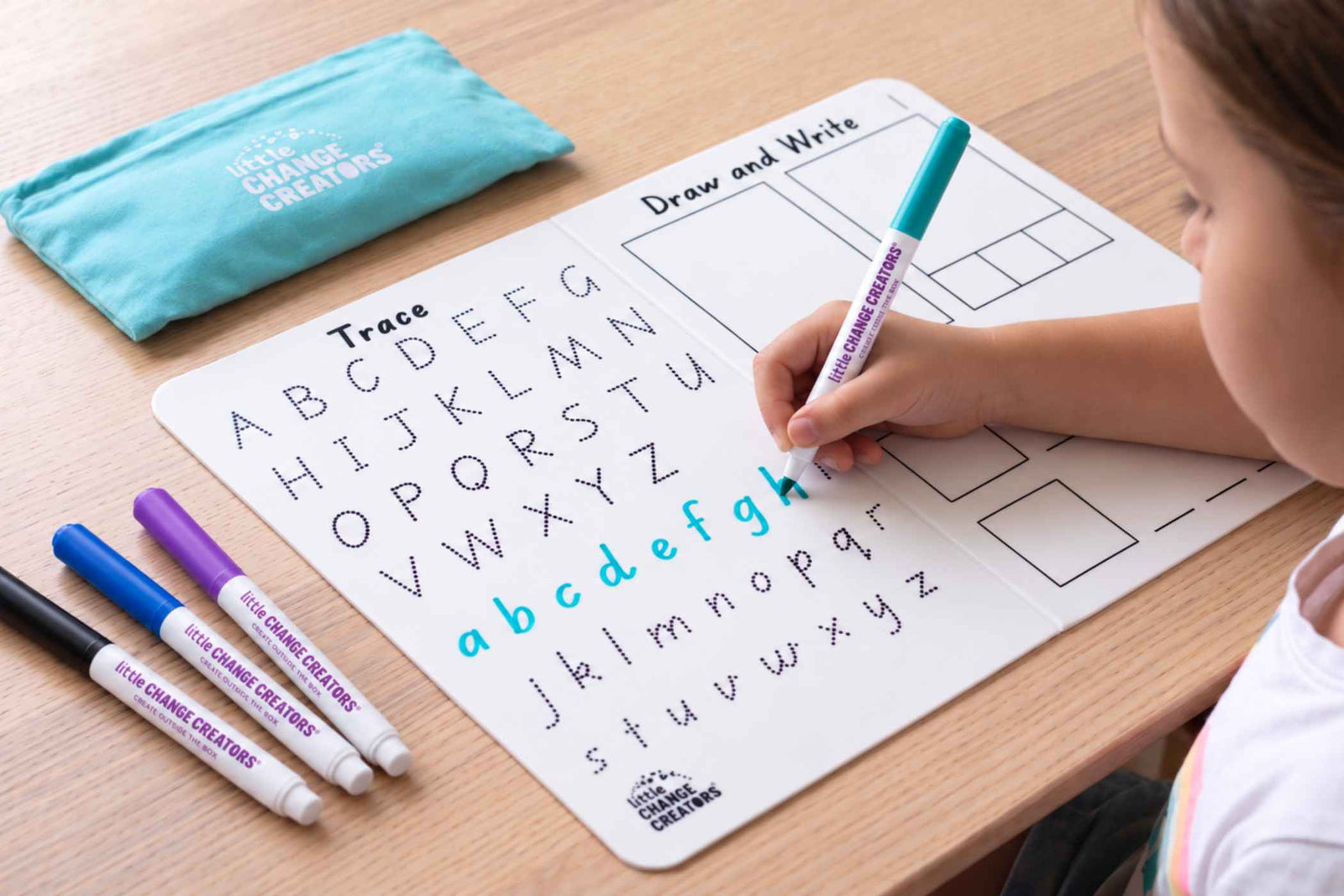
The Play, Trace and Say, Alphabet Letter Formation and Trace activities provide different levels of pre-writing and handwriting practice.
Children can begin with shapes, pathways, loops and other pre-writing movements before progressing to guided letter formation and alphabet tracing.
Numbered directional arrows on the Alphabet Letter Formation activity show children where to start and how to move through each letter. Dry-erase markers allow the movements to be repeated, while playdough can add another tactile way to form shapes and patterns.
This creates a progression from movement → control → guided formation → repeated handwriting practice.
Hearing the sounds inside words
AC9EFLY09–10 · Phonological awareness
Phonological awareness is about recognising and working with the sounds of spoken language before or alongside connecting those sounds with written letters.
At Foundation level, children explore rhymes, syllables and phonemes, then learn to orally blend and segment single-syllable words and manipulate individual sounds.
How our activities support this learning
The Trace and Say activity creates an early bridge between visual recognition, spoken language and sound.
Children trace familiar objects such as a sun, apple, tree, pan, igloo and net, say each word aloud and listen for its initial sound: S, A, T, P, I, N.
The Draw and Write: Sound It Out activity takes this further by asking children to listen for the individual sounds within a word and represent them from left to right.
Rather than jumping straight to spelling, children first learn to hear how spoken words can be broken apart and put back together.
Connecting letters with sounds
AC9EFLY11 · Letters and sounds
Foundation students learn to recognise and name uppercase and lowercase letters and know the most common sound represented by each letter.
How our activities support this learning
Several activities deliberately connect visual letter recognition with spoken sounds.
Children encounter uppercase and lowercase letters through Alphabet Letter Formation and Trace, while Trace and Say introduces the idea that a familiar picture can be connected to the first sound in its name.
These activities can be used alongside explicit phonics instruction to give children another way to revisit the letter-sound relationships they’re learning.
Moving from sounds to CVC words
AC9EFLY12–13 · Early decoding and spelling
In Foundation, children learn to write consonant-vowel-consonant, or CVC, words by representing sounds with appropriate letters. They also use their developing knowledge of letters and sounds to make spelling choices.
Think words such as cat, sun and pig: three sounds that can be heard, segmented and represented individually.
How our activities support this learning
This principle sits at the heart of Draw and Write: Sound It Out.
The activity begins with simple three-letter words children can sound out letter by letter. As their skills develop, the number of sound boxes increases to introduce four- and five-letter words.
That progression is intentional. Children aren’t simply being given longer words; they’re being encouraged to transfer the same process of listening, segmenting and representing sounds to increasingly challenging words.
The companion Picture to Word activity then removes the individual sound boxes, encouraging children to apply their phonics and spelling knowledge more independently.
Building a bank of familiar words
AC9EFLY14 · Familiar and high-frequency words
Foundation children also begin reading and writing familiar and commonly encountered high-frequency words.
How our activities support this learning
As children use Draw and Write and Finish the Sentence, they can practise familiar words alongside words they are constructing through phonics.
Because the activities aren’t single-use worksheets, teachers and families can vary the vocabulary and prompts to match the words an individual child is currently learning.
Understanding sentences and creating early texts
AC9EFLA05–06 and AC9EFLY05–06
At Foundation level, children begin understanding that sentences communicate ideas and that words work together to create meaning. They also begin creating short texts through combinations of writing, drawing and other representations.
How our activities support this learning
Finish the Sentence provides scaffolding between writing individual words and constructing complete thoughts.
The earliest prompts provide sound boxes and predictable sentence structures. Later prompts become increasingly open-ended, giving children more responsibility for deciding what they want to say and how to write it.
Write a Story extends this again by giving children space to sequence an idea using First, Next and Then. Younger children can rely more heavily on pictures and emerging writing, while increasingly confident writers can add words and sentences.
The goal isn’t to rush children towards independent story writing. It’s to provide stepping stones that make getting there feel achievable.
Building everyday vocabulary
AC9EFLA08 · Vocabulary
Foundation students develop vocabulary connected with familiar experiences, interests and topics explored at school.
How our activities support this learning
The Today activity creates opportunities to use everyday vocabulary around dates, days of the week and weather.
Simple conversations such as What’s the weather like today?, What day comes after Tuesday? or How is today’s weather different from yesterday’s? can turn a quick daily routine into a language-rich learning opportunity.
Year 1
As children move into Year 1, the focus shifts from establishing foundational literacy skills towards applying them with greater independence.
AC9E1LA06–07 · Building sentences
Children explore how simple sentences are structured and how different words contribute meaning.
Re-LEARN-able connection: Finish the Sentence can progress from highly scaffolded responses towards increasingly open-ended sentences, helping children think about how words fit together to communicate a complete idea.
AC9E1LE03 & AC9E1LE05 · Understanding and creating stories
Year 1 students explore story features such as characters, settings and plot, and can retell or adapt familiar stories through speaking, writing, drawing and other forms. The curriculum includes discussion of how plots develop through beginnings, complications and resolutions.
Re-LEARN-able connection: Create and Write a Story encourage children to use drawings and writing to develop characters, settings and sequences of events.
AC9E1LY06 · Creating and editing texts
Children create short written texts using simple sentences, vocabulary, spelling and sentence punctuation.
Re-LEARN-able connection: Finish the Sentence and Write a Story give children structured spaces to practise these skills. The story-writing checklist also introduces the habit of looking back over a piece of writing rather than treating the first attempt as automatically finished.
AC9E1LY08 · Handwriting
Children continue developing clear, unjoined uppercase and lowercase handwriting.
Re-LEARN-able connection: The letter formation and alphabet tracing activities remain useful beyond the initial learning of letter shapes, particularly when children need additional practice developing consistency and control.
AC9E1LY09–14 · Developing phonics and spelling
Year 1 phonics and spelling build on Foundation knowledge as children work with increasingly complex sound combinations, vowel patterns, blends and digraphs, while increasing the number of familiar words they can recognise and spell.
Re-LEARN-able connection: The progression from three-letter words to four- and five-letter words in Draw and Write allows educators to adjust the challenge to suit the child’s current phonics knowledge.
Year 2
By Year 2, children are expected to apply many of these skills with greater fluency and independence.
AC9E2LA06 · Extending sentences
Children begin moving beyond simple sentence structures and combining ideas in more sophisticated ways.
Re-LEARN-able connection: The later Finish the Sentence prompts provide less scaffolding, allowing children to generate more of the sentence themselves.
AC9E2LE05 · Creating literary texts
Year 2 students create and edit literary texts by adapting familiar structures and language features through drawing, writing and other forms.
Re-LEARN-able connection: Write a Story gives children a reusable planning space for developing and sequencing their own narrative ideas.
AC9E2LY06 · Creating and editing written texts
Children create and edit written texts using increasingly developed sentence structures, vocabulary, spelling and punctuation.
Re-LEARN-able connection: Finish the Sentence and Write a Story can be used with progressively higher expectations. The mat stays the same; what changes is the complexity of the child’s response.
AC9E2LY08 · Handwriting fluency
By Year 2, children continue working towards legible, increasingly fluent letter formation.
Re-LEARN-able connection: Reusable tracing and writing areas provide opportunities for targeted handwriting practice without needing to introduce a new worksheet every time.
AC9E2LY09–11 · More complex phonics and spelling
Children apply increasingly sophisticated knowledge of sounds, letter patterns and spelling conventions.
Re-LEARN-able connection: The more challenging Draw and Write prompts can be used to practise words appropriate to the phonics patterns being taught, rather than limiting children to the earliest CVC stage.
How the Literacy Set connects with the EYLF V2.0
The Early Years Learning Framework V2.0 takes a broad view of literacy. It describes literacy as encompassing oral, written, visual and auditory language, including talking, listening, viewing, composing, storytelling, reading and writing. It also recognises strong oral language as an important foundation for ongoing literacy learning.
Three EYLF outcomes have particularly strong connections with the Literacy Activity Set.
Outcome 3 · Children have a strong sense of wellbeing
Physical development is part of children’s readiness to engage with writing tools and other learning materials.
How the set supports it: tracing, drawing, marker control, letter formation and playdough activities provide opportunities to practise the coordinated small movements involved in early writing.
Outcome 4 · Children are confident and involved learners
The EYLF describes confident and involved learners as developing dispositions including curiosity, creativity, confidence and persistence, as well as skills in problem-solving, experimentation and investigation. It also encourages opportunities for children to revisit ideas and extend their thinking.
How the set supports it: reusable activities can be revisited rather than treated as one-and-done tasks. Children can try something, wipe it away, practise again and take on a more difficult version when they’re ready.
That makes progression part of both the activity design and the way the resource can be used.
Outcome 5 · Children are effective communicators
This is the strongest EYLF connection to the Literacy Set.
Outcome 5 encompasses children’s interactions with texts, their use of different media to express ideas and their growing understanding of symbols and pattern systems. The EYLF specifically identifies early awareness of sounds in language, letter-sound relationships and text structures.
How the set supports it: children progress from recognising shapes and sounds to forming letters, constructing words, completing sentences and eventually creating their own stories. Drawing and oral discussion can sit alongside writing, recognising that literacy development involves much more than putting pencil to paper.
At a glance: Literacy curriculum alignment
|
Learning area |
Re-LEARN-able™ activities |
Key Australian Curriculum links |
EYLF |
|
Pre-writing & fine motor |
Play, Trace and Say |
Supports AC9EFLY08 |
Outcomes 3, 4 |
|
Letter formation |
Alphabet Letter Formation, Trace |
AC9EFLY08, AC9E1LY08, AC9E2LY08 |
Outcomes 3, 5 |
|
Phonological awareness |
Trace and Say, Sound It Out |
AC9EFLY09–10 |
Outcomes 4, 5 |
|
Letters & sounds |
Trace and Say, alphabet activities |
AC9EFLY11 |
Outcome 5 |
|
Phonics & spelling |
Draw and Write |
AC9EFLY12–14, AC9E1LY09–14, AC9E2LY09–11 |
Outcomes 4, 5 |
|
Sentence construction |
Finish the Sentence |
AC9EFLA05–06, AC9E1LA06–07, AC9E2LA06 |
Outcomes 4, 5 |
|
Storytelling & text creation |
Create, Write a Story |
AC9EFLY05–06, AC9E1LE03, AC9E1LE05, AC9E1LY06, AC9E2LE05, AC9E2LY06 |
Outcomes 4, 5 |
|
Everyday vocabulary |
Today |
AC9EFLA08, AC9E1LA09 |
Outcomes 4, 5 |
One resource, room to grow
The Re-LEARN-able™ Literacy Activity Set isn’t designed around the idea that every child of the same age should be doing exactly the same thing.
Instead, its reusable activities provide multiple entry points and a clear progression.
A child might be tracing pre-writing patterns while another is practising letter formation. One learner might be sounding out a three-letter word while another is constructing a sentence or developing a story.
And when they’re ready for the next step, the resource is ready too.