
Why Reusable Creative Play Resources Are Becoming Every Parent's Secret Weapon
It was 4:30pm. Dinner needed cooking, the washing basket was overflowing, and my child had reached that familiar stage of the day where boredom seemed to arrive all at once.
"Can I watch something?"
It's a question many parents hear daily.
Most of us want our kids to spend less time on screens and more time creating, exploring, and using their imaginations. But when you're juggling work, school drop-offs, household chores, and the endless demands of family life, setting up elaborate craft activities isn't always realistic. The glitter, glue, paint spills, and half-finished projects can sometimes create more stress than enjoyment.
That's why many families are turning to practical, reusable creative play resources that make it easy to offer screen-free activities for kids without creating extra work for parents. Instead of disposable activities that create mess and waste, they're choosing products that can be used again and again, whether at home, in the car, at a café, or while travelling.
And interestingly, research suggests this approach may offer benefits that many parenting websites rarely discuss.
The Creative Play Benefit Most Parents Haven't Heard About
When people talk about creative play, they usually mention imagination, self-expression, and fine motor skills.
While those benefits are important, there's another advantage that receives far less attention: executive function development.
Executive functions are the mental skills children use to plan, focus attention, remember instructions, solve problems, and manage emotions. These skills play a major role in school readiness, learning, and everyday life.
A 2026 meta-analysis examining 26 studies found a significant relationship between pretend play and executive function development in early childhood.
In simple terms, when kids invent stories, create imaginary worlds, or find multiple ways to use the same object, they're exercising the very skills that help them become flexible thinkers and problem-solvers.
This means that simple reusable colouring activities, storytelling prompts, and open-ended creative resources may be doing much more than simply keeping kids entertained.
The Real Challenge Isn't Creativity — It's Consistency
Most parents don't struggle with wanting their kids to be creative.
They struggle with finding activities that are practical enough to use regularly.
According to Australian research on barriers to play, which surveyed 2,036 Australian parents representing 3,351 children, 86% say it is hard to find time to play with their children.
The takeaway isn't that parents need to carve out more hours in the day.
It's that creative play needs to fit around real family life.
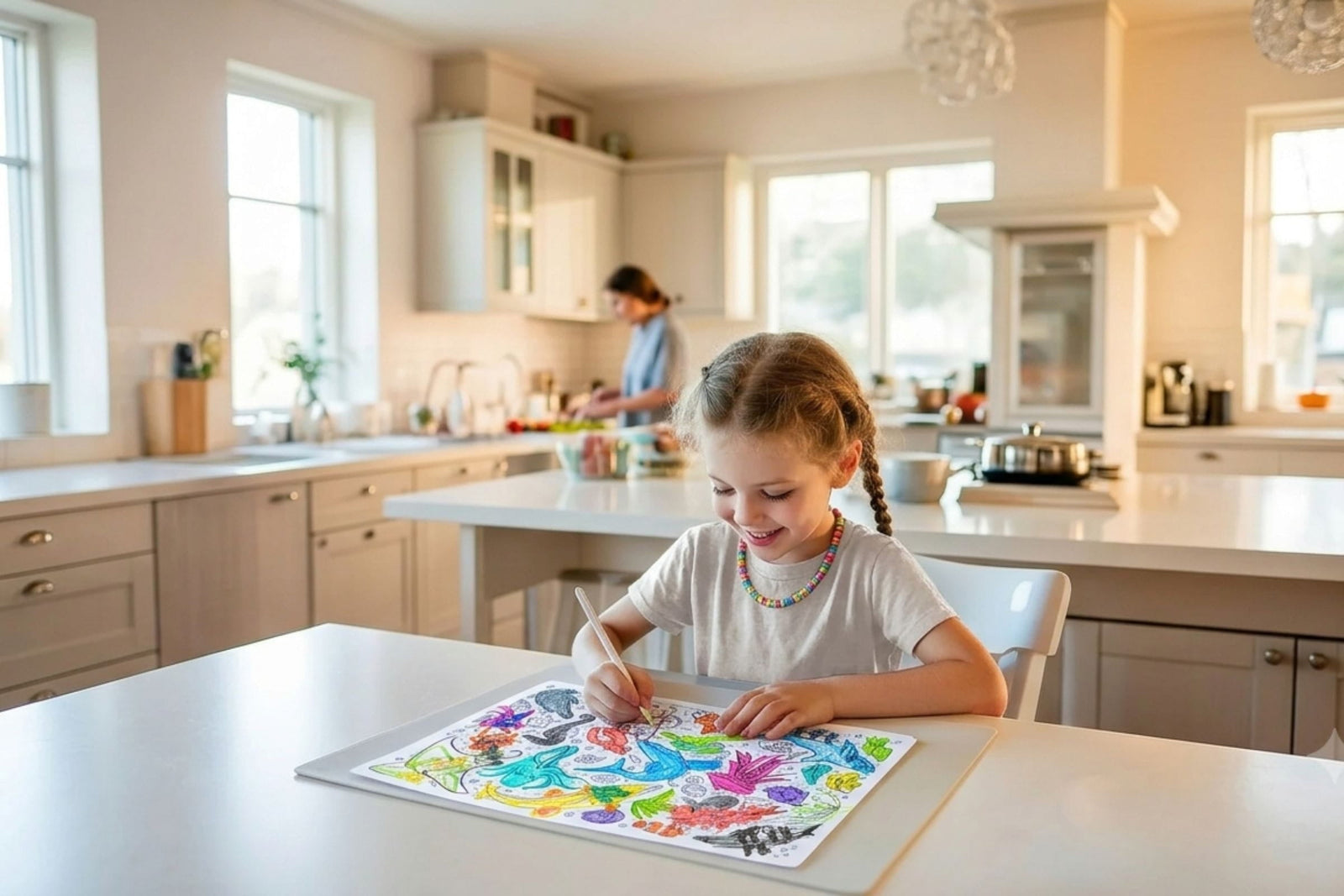
The most valuable creative activities aren't always the most elaborate. They're the ones kids can enjoy at a moment's notice, without loads of preparation, constant supervision or hours of clean-up.
When creative play is simple to set up and easy to access, it becomes something families can enjoy more often. And when it comes to nurturing creativity, consistency matters far more than perfection.
Why Reusable Resources Often Inspire Better Play
Many traditional art and craft activities are designed around a single outcome.
Colour the picture.
Build the project.
Follow the instructions.
Throw it away.
Reusable creative play resources work differently.
Because kids can return to them repeatedly, they naturally encourage experimentation. A child might use the same resource for drawing one day, storytelling the next, and imaginative role-play the following week.
Research on children’s object play development shows that kids learn to use familiar materials in increasingly creative ways over time. Open-ended resources encourage flexibility, exploration, and innovation because there isn't one "right" way to play.
In many cases, fewer rules create more creativity.
The Hidden Link Between Creative Play and Screen Time
Many parents see creative play and screen time as separate issues.
They're actually closely connected.
According to Australian screen-based activity statistics, 90% of children aged 5–14 take part in screen-based activities for at least an hour a week, and the share spending 20 or more hours a week on screens has grown to almost one in four.
At the same time, reading and other non-screen activities have declined.
Australian research on children’s screen time found that children who regularly participate in enjoyable activities tend to spend less time using screens.
This suggests that reducing screen time isn't always about taking something away.
Often, it's about providing something more engaging in its place.
For parents looking for practical ways to encourage healthier screen habits, our guide to screen-free activities for kids shares simple ideas that help children stay engaged, creative and connected without relying on technology.

What Busy Parents Should Look For in Creative Play Resources
Not all creative play resources are created equal.
If your goal is to encourage creativity without creating extra work for yourself, look for resources that meet these criteria:
Reusable
Children should be able to use the product repeatedly without needing replacement materials after every session.
Open-Ended
The activity should allow multiple ways to play rather than leading to a single finished outcome.
Portable
The best travel activities for kids are lightweight, compact, and easy to take anywhere. Whether you're heading to a restaurant, waiting room, holiday destination, or simply visiting grandparents, portable creative resources can transform idle moments into opportunities for learning and play.
If you're planning a family trip or simply need ideas for keeping kids entertained while out and about, our collection of travel activities for kids can help make those in-between moments easier and more enjoyable.
Easy to Clean
Mess-free activities for kids are often the activities parents reach for most often. If a product requires a major clean-up afterwards, it's less likely to become part of your regular routine.
Independent
The best resources allow kids to engage without needing constant adult direction, giving parents a few precious moments to tackle other tasks.
When these elements come together, creative play becomes part of everyday life rather than a special event requiring significant planning.
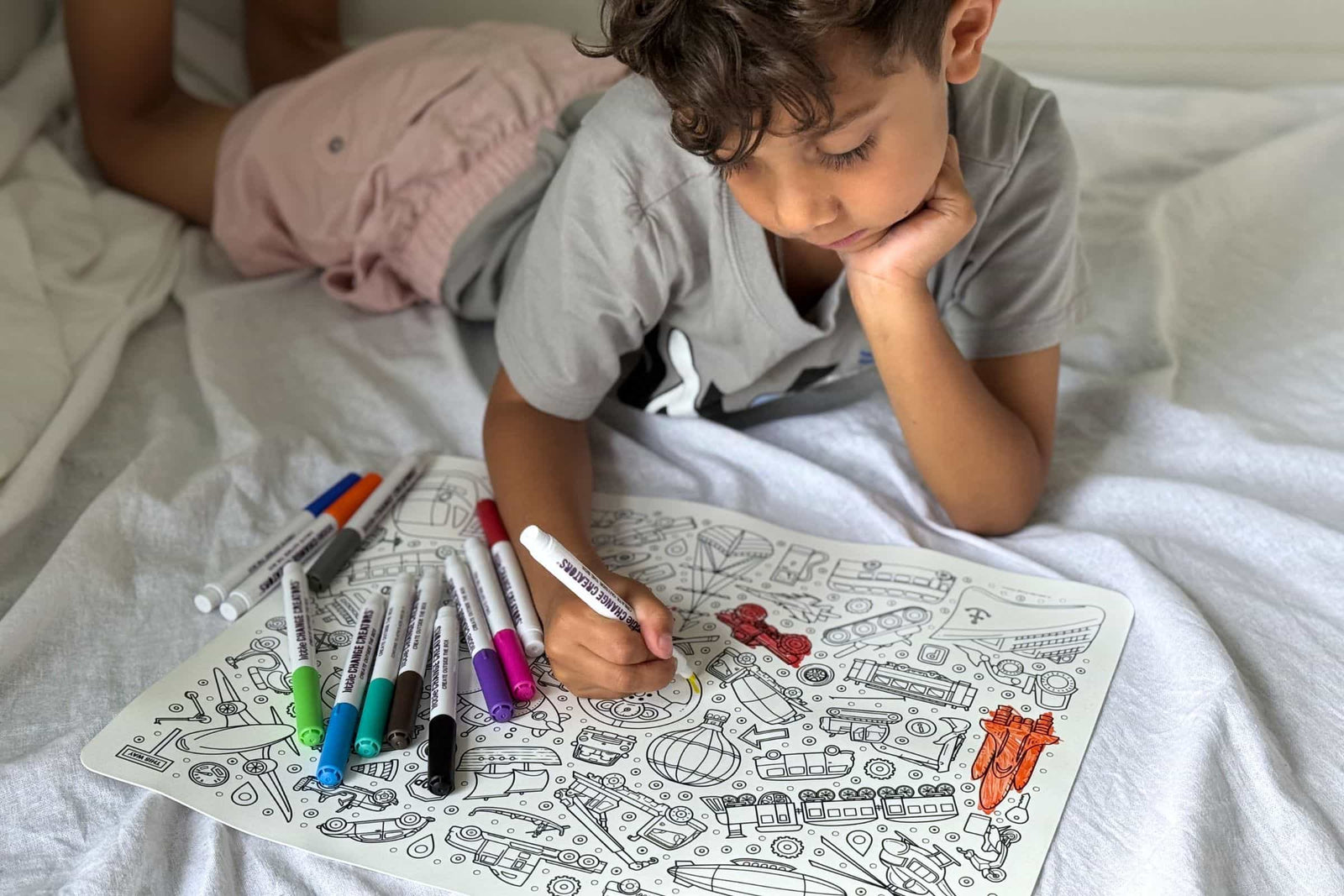
Little Change Creators' reusable colouring activities were designed around exactly this brief: wipeable, reusable silicone mats that pack down small enough for a handbag and clean up with a damp cloth.
Sustainability Matters Too
One aspect often overlooked in conversations about children's activities is waste.
Many traditional craft projects involve disposable materials, single-use kits, excessive packaging, and projects that quickly end up in the bin.
Reusable creative resources offer a more sustainable alternative.
Not only do they reduce household waste, but they also teach kids an important lesson: creativity doesn't require constant consumption.
Children can create hundreds of different experiences using the same resource when given the opportunity to experiment and explore.
This shift from "use once and discard" to "use again and create differently" mirrors the values many families are trying to teach at home.
Simple Creative Play Ideas That Require Almost No Preparation
If you're looking for creative play ideas for kids that encourage imagination without requiring hours of preparation, try:
- Reusable colouring activities that can be wiped clean and used repeatedly
- Inventing new endings to favourite books
- Creating imaginary cafés, shops, or restaurants
- Building miniature worlds using household objects
- Designing treasure hunts around the home
- Making up characters and adventures together
- Collaborative doodling where each family member adds to the same picture
- Storytelling games during car trips and family travel
If you're looking for even more inspiration, Little Change Creators has put together a helpful guide featuring practical mess-free activities for kids that can be set up in minutes and enjoyed repeatedly without creating extra work for parents.
The goal isn't perfection.
The goal is giving kids opportunities to think, create, imagine, and explore.

Making Creative Play Easier for Families
For many families, the biggest challenge isn't understanding the importance of creative play. It's finding resources that fit into real life.
Little Change Creators designs reusable, mess-free, travel-friendly creative play resources for exactly this reason: so busy parents can offer their kids a creative outlet without the stress, waste, or preparation time that traditional arts and crafts often demand.
When creative play is simple for parents, it becomes more accessible for children too.
Conclusion
Creative play doesn't need to involve glitter-covered tables, overflowing craft cupboards, or hours of preparation.
In fact, some of the most valuable creative experiences come from simple, reusable resources that encourage imagination, problem-solving, and independent thinking. Research continues to show that play supports important cognitive skills, while practical, open-ended activities can help kids spend less time on screens and more time engaging with the world around them.
For busy families, the future of creative play isn't about doing more. It's about choosing smarter, reusable resources that make creativity easy enough to become part of everyday life.
Frequently Asked Questions
What are creative play resources?
Creative play resources are tools, toys, or activity sets that give kids an outlet for imagination, drawing, storytelling, or hands-on making. The best creative play resources are open-ended, meaning they support many different types of play rather than leading to one fixed outcome.
Why are reusable creative play resources better for busy families?
Reusable creative play resources can be used again and again without needing replacement materials, lots of clean-up, or constant supervision. This makes them easier for time-poor parents to offer consistently, which matters more for a child's development than any single elaborate activity.
How do creative play resources support child development?
Open-ended creative play resources encourage children to invent, problem-solve, and use flexible thinking. Research links pretend and imaginative play to stronger executive function skills, the mental abilities kids use to plan, focus, and manage their emotions.
Are creative play resources a good alternative to screen time?
Yes. Research suggests kids who regularly engage in enjoyable offline activities tend to spend less time on screens. Accessible, low-prep creative play resources give children something more engaging to choose in place of a screen.
What should I look for when choosing creative play resources?
Look for creative play resources that are reusable, open-ended, portable, easy to clean, and able to be used independently by your child. Resources that tick all five make it much easier to build creative play into everyday routines.
About the author

Paige McInnes is an Australian Small Business Champion, former IKEA designer, parent and founder of Little Change Creators, a People + Planet First Verified social enterprise. Drawing on experience in education, law enforcement and design, she creates practical, reusable creative play resources that help busy families nurture children's creativity with less mess, less waste and less stress.